Eight onboarding systems, one lifecycle surface.
An institutional client onboarding platform that moves a client from first request to ready-to-trade across Sales, Client Service, Compliance, Credit, Legal, and Operations.
Eight systems unified into one lifecycle, with ~40% fewer intake fields (directional)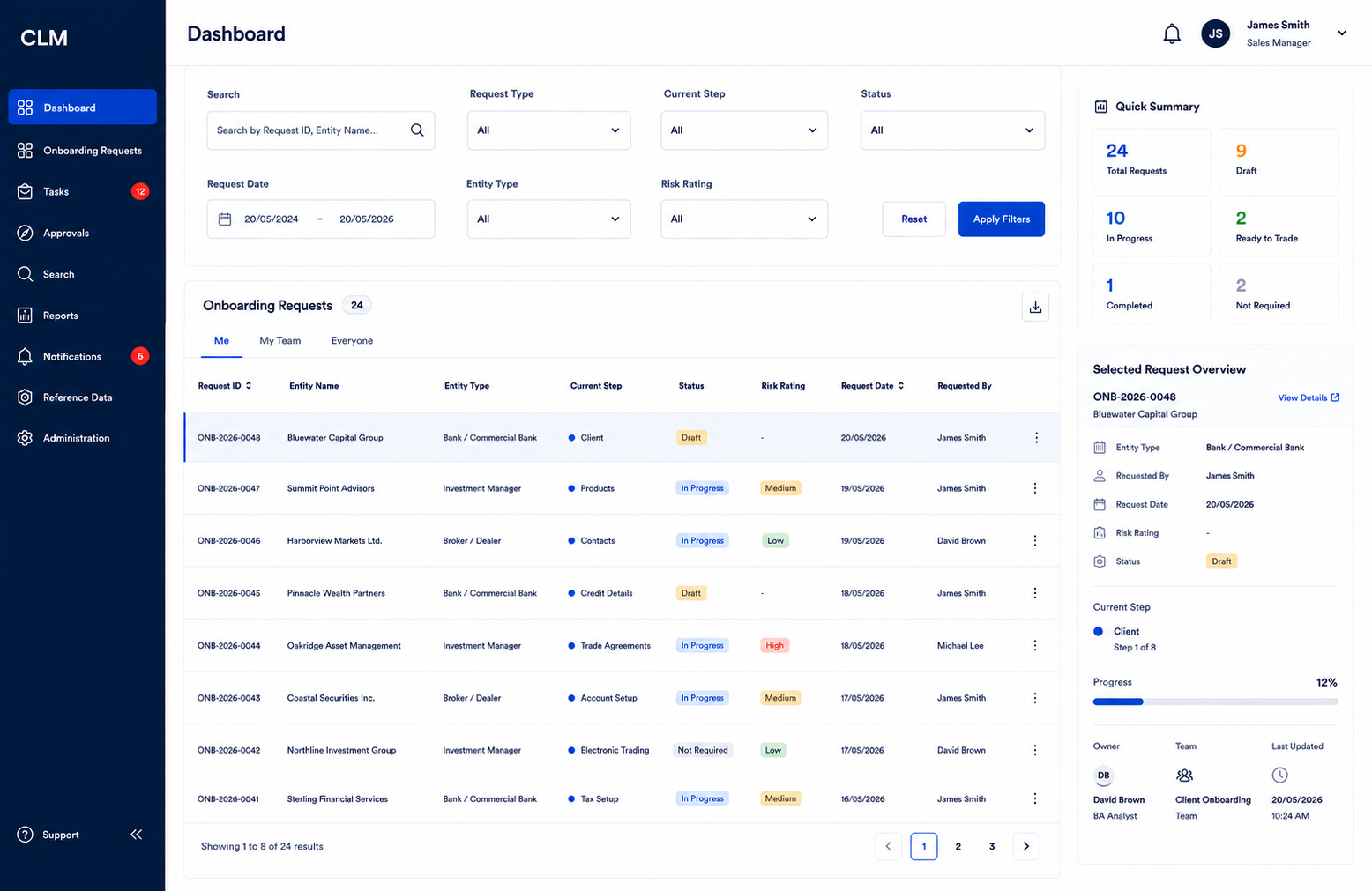
Some details and screens have been simplified or anonymized to respect confidentiality.
The project on one page.
- Role
- Senior Product Designer and workflow lead. Accountable end to end.
- Timeline
- 2025 to May 2026. Discovery through incremental rollout.
- Team
- Product, business analysts, engineering, QA, and the operating teams.
- Business context
- Institutional client onboarding across eight downstream systems.
- Users
- Sales, Client Service, Operations, KYC & Compliance, Credit, Legal, Leadership.
- Responsibilities
- Discovery, workflow and IA, interaction design, decisions, UAT, rollout.
- Deliverables
- Lifecycle model, IA, dashboard, intake, role-based views, design patterns.
- Impact
- Eight systems on one surface, ~40% fewer intake fields (directional), spreadsheets retired.
An operational problem before a UI one.
Fragmentation across eight systems created four distinct kinds of risk.
Customer pain
- No shared view of a request
- Sales chasing status by email
- Re-keying data across systems
- Blockers surfaced late
Business impact
- Delays hold up revenue
- A spreadsheet as point of failure
- Knowledge in people, not systems
- Inconsistent status erodes trust
Operational
- Eight systems, each a fragment
- Parallel work, hidden dependencies
- Ownership gaps in hand-offs
- Different status per system
Compliance risk
- Decisions must be defensible
- Audit rebuilt after the fact
- Approvals hard to evidence
- Traceability left to memory
Many teams, one shared record.
Every team owns a different decision on the same record. Their needs conflict, and that is where the work lived.
What the platform had to coordinate
What I saw became what I built.
Three weeks of shadowing and workflow mapping, turned into design through one frame.
One lifecycle, four stages, many owners.
The model the whole product sits on. Parallel where the work is parallel, with one clear end state.
The choices I would defend in any review.
Collapsed, each is a headline and result. Open one to see the constraints, options, and trade-off.
01
Minimal intake, deferred detail
~40% fewer intake fields (directional)
Minimal intake, deferred detail
- Problem
- Intake required data Sales did not have and Operations did not need yet. One missing field blocked the request.
- Constraints
- Regulated intake; downstream teams genuinely depend on complete data.
- Options
- Collect everything upfront · minimal intake with progressive disclosure · long phased forms.
- Trade-off
- Downstream teams lose upfront completeness. Built the follow-up tooling they needed instead.
- Decision
- Minimal intake, every other field deferred to the stage that needs it.
- Outcome
- Directional: roughly 40% fewer required intake fields; a faster path into the lifecycle.
02
A shared lifecycle vocabulary
One model across eight statuses
A shared lifecycle vocabulary
- Problem
- The same onboarding read as "in review," "pending docs," and "blocked" across systems.
- Constraints
- Eight systems each own a status; compliance needs precision, Sales needs simplicity.
- Options
- Expose every system status · one plain-language model · a hybrid by role.
- Trade-off
- Plain status can hide fidelity. The full system trace is one click away, not the default.
- Decision
- Plain-language lifecycle stages, with system detail on demand.
- Outcome
- Observed: the lifecycle became the shared language teams used.
03
Role-based views over one model
12+ teams, one lifecycle underneath
Role-based views over one model
- Problem
- Each operations sub-team had its own definition of "this onboarding is mine."
- Constraints
- One shared data model, limited build time, no appetite for training.
- Options
- A dashboard per team · role-aware views on one model · fully custom per user.
- Trade-off
- Less bespoke than a per-team build, but it adopts without training.
- Decision
- Role-aware default views and saved queries over a single record.
- Outcome
- Observed: each team sees its slice while the lifecycle stays universal.
04
Audit trail as a first-class object
Prep cut from weeks to minutes (directional)
Audit trail as a first-class object
- Problem
- Audit was a quarterly export. By the time something needed defending, the trail was gone.
- Constraints
- Regulated and auditable, but the operator must not drown in noise.
- Options
- Quarterly export · reports generated later · capture continuously on the record.
- Trade-off
- Capturing everything risks noise. The activity feed is collapsible and role-filtered.
- Decision
- Every state change captured against the record, queryable in place.
- Outcome
- Directional: compliance reviews the record instead of commissioning a report.
05
Parallel workflows, visible end state
Readiness is shown, not inferred
Parallel workflows, visible end state
- Problem
- KYC, credit, legal, account, trading, and tax setup run at once, with hidden dependencies.
- Constraints
- Downstream systems owned by other teams; the work is genuinely parallel.
- Options
- Force a strict sequence · model true parallelism · silo each system.
- Trade-off
- Parallelism is harder to represent. Solved with per-line progress and one end state.
- Decision
- Parallel product workflows gated by a deliberate Ready-to-Trade milestone.
- Outcome
- Observed: operators see exactly which dependency blocks which product.
Why the product looks the way it does.
Recreated views, client data removed. Open the reasoning under any screen.
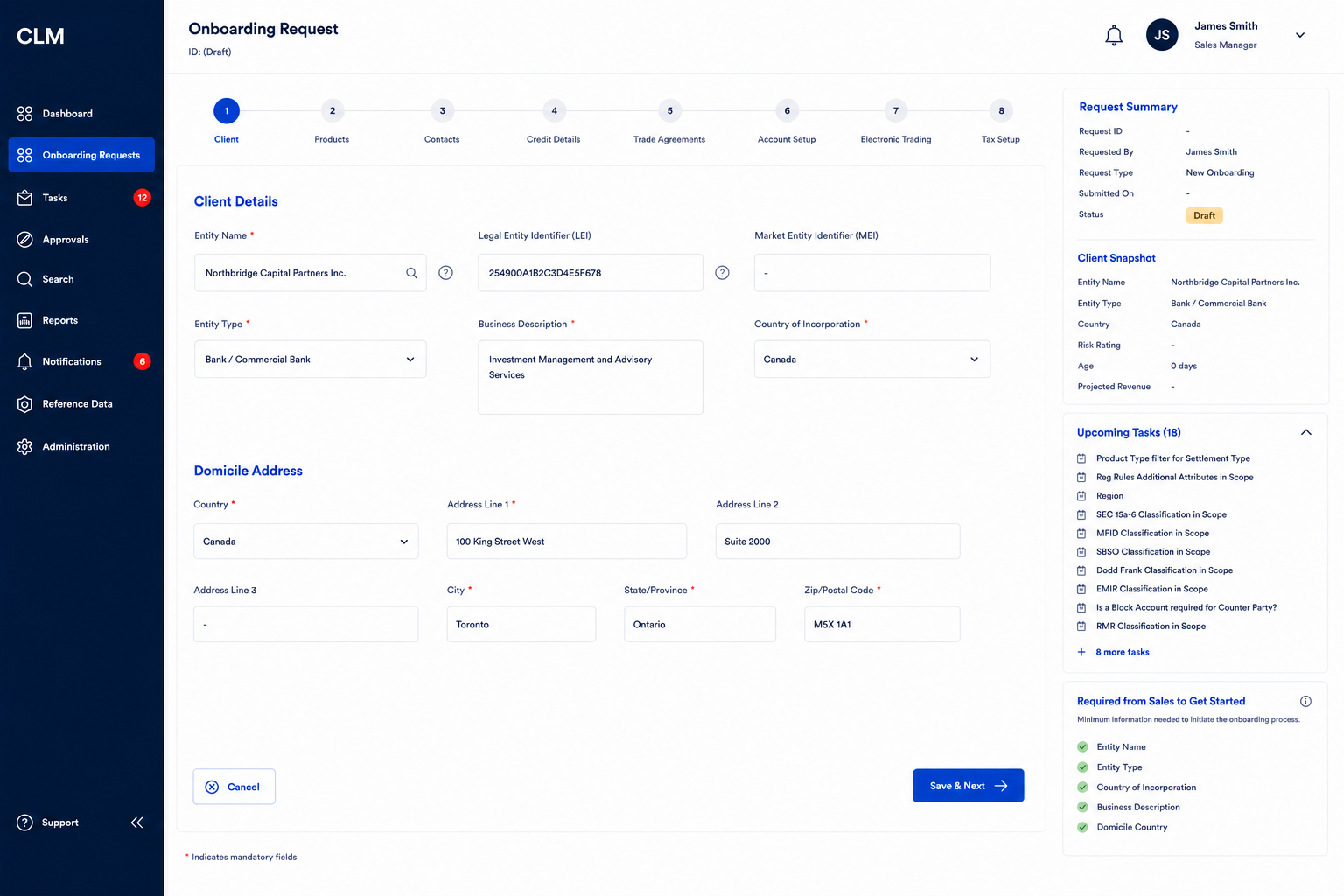
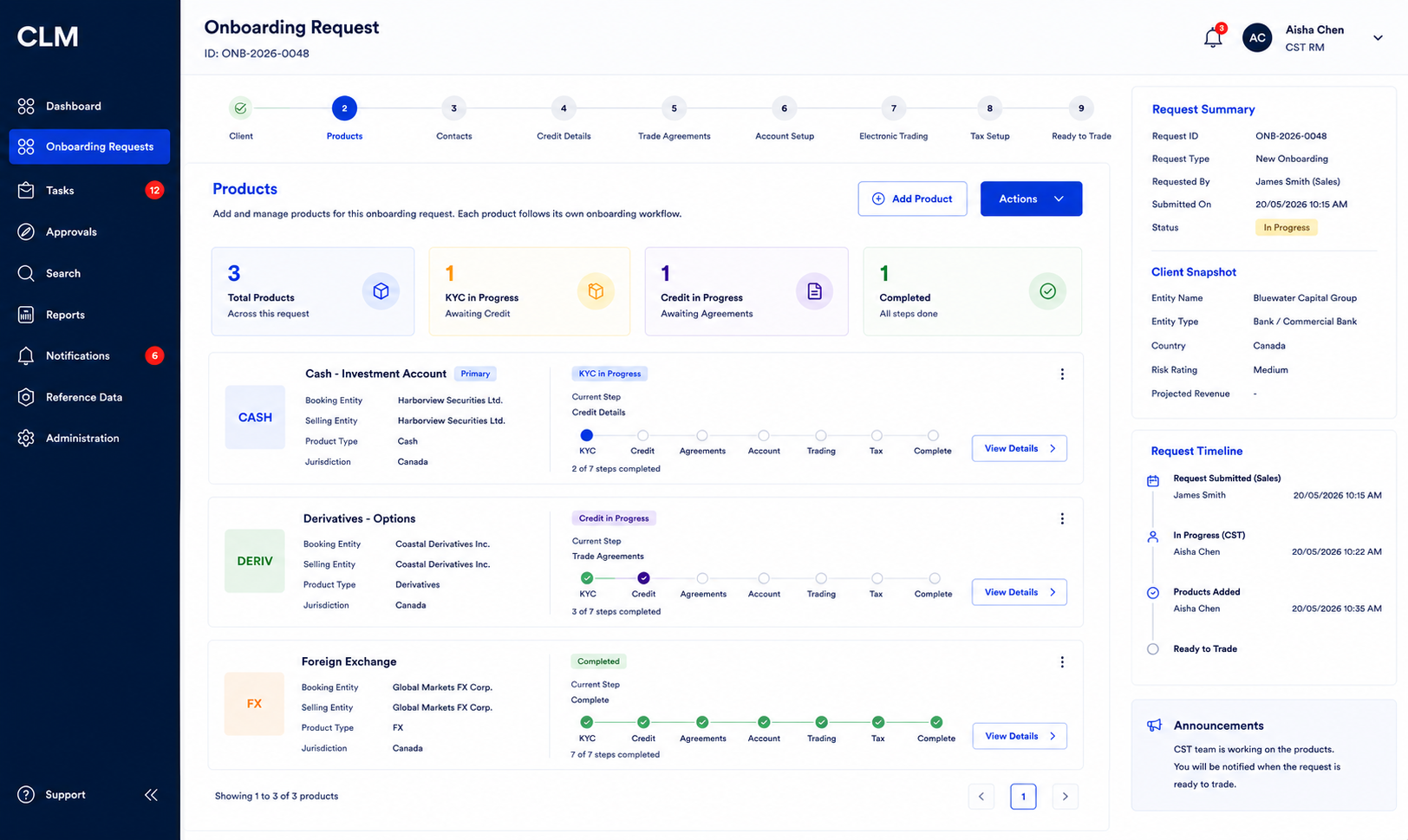
Select a role to see the same record through its lens.
Initiate without translating.
- Fast intake, minimal required fields
- Status in plain language
- Clear ownership of what sales still owes
- No downstream system mechanics
One surface, every request.
- Real-time view of every onboarding
- Filter by team, risk, time-in-stage
- Product state at line-item granularity
- Deliberate hand-off into Ready to Trade
Review the record, not a report.
- Regulatory and risk validation
- Structured entity data and disclosures
- Audit-ready trail of every change
- Follow-up requests back to sales
Defensible by default.
- Every change logged automatically
- Compliance-ready without exports
- Portfolio view across onboardings
- Queryable from the surface
Beyond screens, into patterns.
Built on RBC's enterprise design system, extended only where the workflow needed something new.
The system's foundation
- Tables, filters, forms, and navigation components
- The system's tokens, spacing scale, and typography
- Its accessible defaults, inherited with the components
New patterns it lacked
- The lifecycle status pattern and its state variants
- Role-based views over a shared data model
- The audit activity feed, collapsible and role-filtered
One status pattern, four states, communicated by shape and label as well as colour, so it never depends on colour alone.
Alignment was the design work.
In a regulated, multi-team operation, most of the leverage was in agreement, not pixels.
Where we disagreed, and how it resolved
Downstream teams wanted Sales to collect every field at intake. Sales could not, and it blocked requests.
Progressive disclosure, plus follow-up tooling so downstream teams could request detail at the right stage.
Each team wanted its own dashboard, which would fragment the data and slip the timeline.
Role-based views over one shared model: each team gets its slice, the record stays single.
Discovery, lifecycle mapping, IA, interaction design, the tradeoffs, design-side UAT and rollout.
The model and scope with PM and BAs; feasibility with engineering; regulated flows with compliance and legal.
PM owned delivery; engineering and QA owned build and testing; compliance, credit, and legal owned the decisions.
Outcomes, not outputs.
Teams retired their spreadsheets. The clearest signal the product was working.
Sales stopped emailing "where is this." Status lives where they work.
Telemetry was instrumented after launch, so quantitative figures are directional estimates or adoption signals, labeled as such.
What I'd change, and where this goes next.
Ship instrumentation with the product.
Some numbers are directional because telemetry came after launch. Measurement should launch with it.
Design the operating model, not the screen.
In enterprise work the model everyone agrees on outlives any single interface.
How AI would improve this workflow · forward-looking, not shipped
Future concept · the RBC platform used no AIFuture opportunities