A Salesforce-based auto insurance quoting platform for direct customers.
Designing inside Salesforce Lightning — minimal-data quoting, SLDS-aligned components, and the slow work of getting underwriting rules to coexist with a usable form.
- Client
- BrokerLink Auto Insurance
- Role
- UX Consultant Freelance, Salesforce project
- Timeline
- 2024 — 2025 End-to-end design
- Platform
- Salesforce / SLDS Lightning components
An auto insurance quote, without the manual back-and-forth.
The old quote process required too many manual steps. The new product had to feel like a self-service experience while still respecting the underwriting business it sits on top of.
BrokerLink wanted to give direct customers a way to request auto insurance quotes online — with as little manual input as possible, and as few handoffs as possible. The system needed to live inside Salesforce so the rest of the business — brokers, underwriters, CRM — could plug into the same data.
The design challenge was at the intersection of three things: a customer who wants a fast quote, a business that needs specific data to price risk, and a platform (Salesforce Lightning) with its own opinions about how forms should work.
End-to-end intake design inside Salesforce.
Designed the full quote intake flow
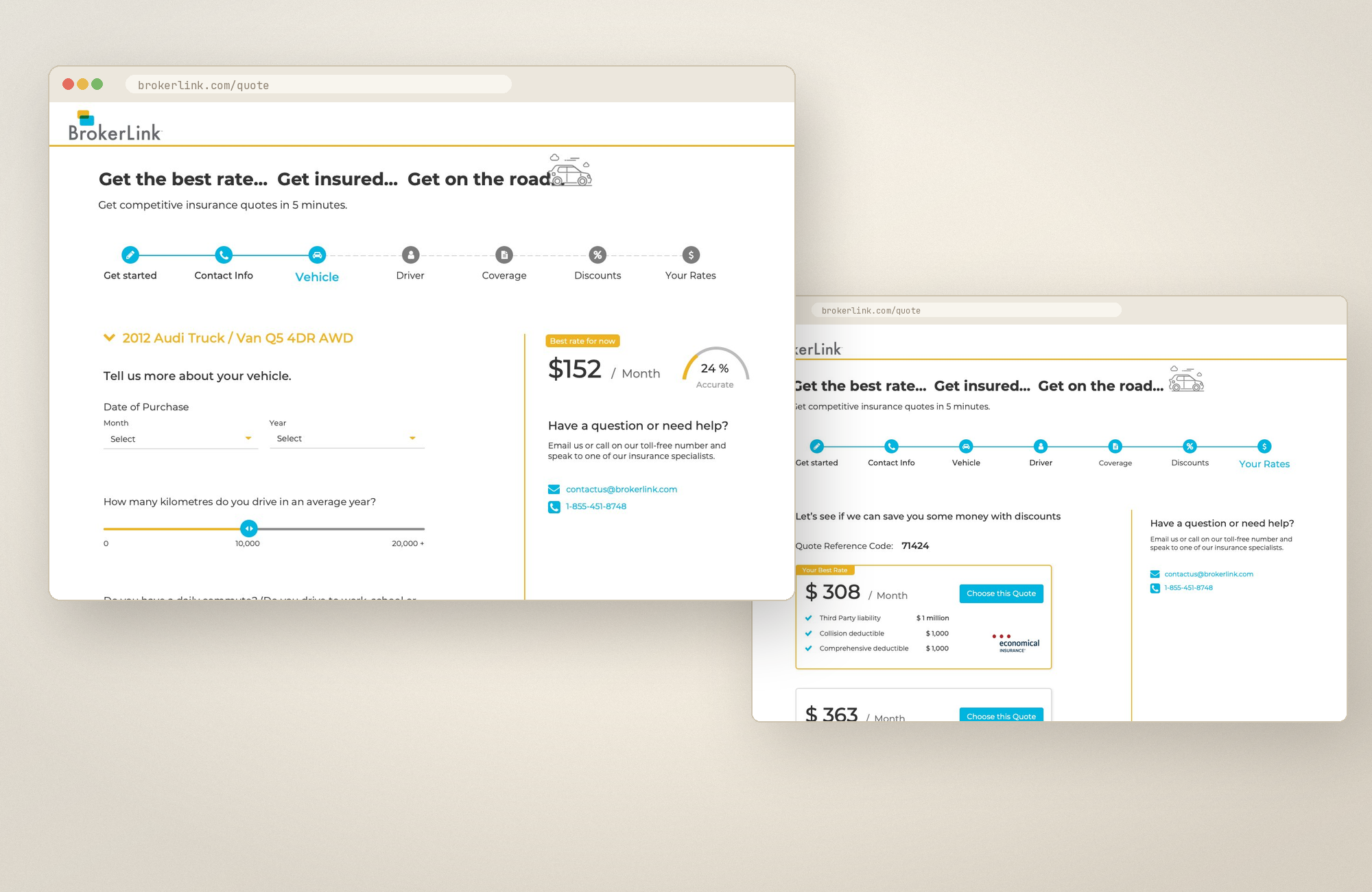
End-to-end customer journey for requesting an auto insurance quote — minimal-input vehicle and customer details, progressive disclosure as the request firmed up.
Form patterns tuned for completion
Field grouping, input types, inline validation, and error recovery — designed to keep customers moving forward rather than reading instructions.
SLDS-aligned components
Built within Salesforce Lightning Design System — keeping the experience platform-coherent while pushing where the defaults didn't serve the customer well.
Salesforce workflow integration
Designed how the customer-facing intake hands off to internal Salesforce workflows — so the quote becomes a record the business can act on, not a form-submission email.
Two real tensions, navigated in parallel.
The hard part of this project wasn't drawing screens. It was deciding what to ask and when — and how much to fight Salesforce when it disagreed.
How little can we ask, and still produce a useful quote?
Auto insurance pricing depends on a lot of variables — driver history, vehicle details, postal code, prior claims. Every variable the customer has to enter is a chance to lose them. We negotiated, field by field, what was genuinely required to generate a meaningful quote upfront and what could be deferred to the bind step. The minimal-data quote became the product's anchor.
SLDS sets a floor. Sometimes the floor isn't where you want to start.
Salesforce Lightning has strong opinions about form layout, navigation, and component behavior. Mostly that's a feature — it gives you consistency and accessibility for free. But some defaults are tuned for internal CRM users, not direct customers requesting a quote on their phone. The work was knowing which battles to pick: where to lean on SLDS for speed and which patterns to extend so the experience felt like a product, not a CRM form.
The quote intake, recreated.
What changed.
Directional outcomes — the kind that matter for a quoting product even when precise telemetry isn't part of the engagement.
Simplified quote experience
The customer-facing flow replaced what had been a multi-step, manually intensive process with a guided, self-service intake.
Reduced friction at intake
Fewer fields up-front, progressive disclosure deeper in the flow — less to navigate before a customer sees value.
Faster quote generation
Minimal-data quoting means a customer can get a real number with vehicle and basic personal details — without committing to a full underwriting form first.
Streamlined onboarding into Salesforce
Quote requests land as structured records in Salesforce — ready for broker follow-up or automated next steps, not stuck in an email queue.